
Circular Tech Bootcamp
Hands-on hardware training in Lagos and St. Louis, Missouri, on the same laptops that go back out to the community afterwards.
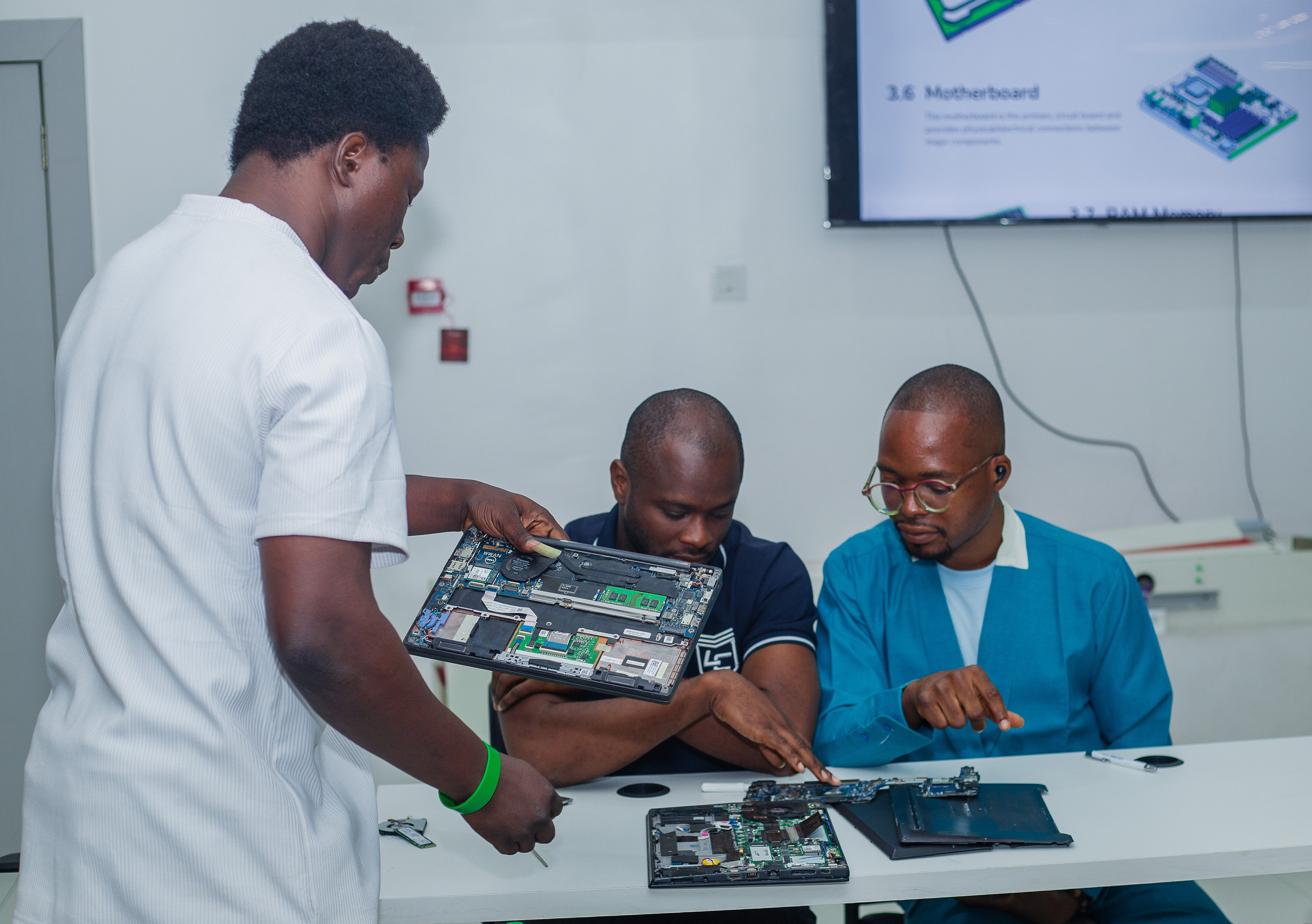
Every device that arrives at JustUsedTech needs assessment before it can be redistributed. The bootcamp turns that necessary work into a curriculum, so the people learning hardware repair are learning on real laptops that are going to real people afterwards, not on spare hardware kept for practice.
The same programme runs in two places. In Lagos it is a jobs-focused course, taking participants through computer hardware from the component level up: identification, assembly and disassembly, troubleshooting, RAM, SSD and battery replacement, maintenance and optimisation, refurbishment, quality testing, and networking basics. Alongside that runs the circular economy and e-waste half, covering environmental impact, reuse and repair principles, safe disposal of damaged components, and community awareness.
In St. Louis, Missouri, it runs with Thomas Dunn Learning Center as a summer programme for participants aged 15 and up, and carries a second track alongside the hardware one: the ethical use of artificial intelligence, covering where these tools fail, bias, privacy, accountability, and digital citizenship. Both cohorts use Google Classroom for materials, assignments, and progress, and both close on a capstone exhibition where teams present what they refurbished or built.
Where it runs
The same programme runs in two places. Here is what each one does, and what they have in common.
Lagos
A workforce development cohort, built around hardware assembly, troubleshooting, and refurbishment, with circular economy and e-waste education running alongside and participants supporting real collection drives.
St. Louis, Missouri
Run with Thomas Dunn Learning Center, a community learning hub with over 9,000 annual visits and 900+ classes delivered. Open to participants aged 15 and up, across two tracks: ethical AI use, and computer hardware coupling and refurbishment.
What both share
Both are blended: instructor-led sessions and hands-on lab work in the room, Google Classroom for materials and assessment, e-waste collection supplying the laptops the training runs on, and a capstone exhibition to finish.
What the programme is for
What the programme sets out to achieve.
Hardware skills
Train participants on computer hardware assembly, troubleshooting, and refurbishment through physical practical sessions and lab work.
Circular economy literacy
Build practical understanding of circular economy principles, e-waste reduction, and the environmental impact of electronic waste.
Ethical AI use
In the St. Louis cohort, a full track on what AI tools are good for, where they fail, and the bias, privacy, and accountability questions around them, alongside digital citizenship and online safety.
Responsible technology use
Promote digital citizenship and sustainability practice alongside the technical curriculum.
Feed the device pipeline
Collect and refurbish used devices for reuse, redistribution, and future community learning initiatives.
Targets
Figures the programme is working towards. These are planned, not delivered.
50
Youth enrolled and trained on hardware and circular economy skills
85%
Training completion rate
70%
Knowledge improvement, pre and post assessment
20
Devices refurbished and presented at the capstone exhibition
How it runs
The activities that make up the programme.
Hardware training
Component identification, laptop and desktop assembly and disassembly, troubleshooting, RAM, SSD, and battery replacement, maintenance, and networking basics.
Practical lab work
Participants work directly on donated laptops, desktop systems, peripherals, and reusable components.
Circular economy and e-waste education
Environmental impact, reuse and repair principles, safe disposal of damaged components, and community awareness work.
E-waste collection drives
Participants support collection, sorting exercises, and reusable device recovery in their own communities.
Ethical AI track
In St. Louis, Missouri, a parallel track on artificial intelligence in everyday life, bias, privacy, accountability, responsible use of AI tools, and online safety, taught through case studies.
Capstone innovation challenge
Teams refurbish devices, design sustainability solutions, or build awareness campaigns, presented at a final exhibition and graduation event.
Timeline
How the programme is planned to run, month by month.
Week 1 to 6
Setup
Curriculum development, trainer and volunteer recruitment, participant recruitment, device collection, and lab setup.
Month 2
Training delivery
Instructor-led workshops, hands-on lab work, peer learning groups, and practical assessments.
Month 3
Projects and exhibition
Practical projects, mentorship, and the final capstone exhibition.
Month 4
Reporting and evaluation
Programme reporting and evaluation against the training targets.
From the field
Training sessions in Lagos, where participants take laptops apart to learn what is inside them, and the St. Louis sessions run with Thomas Dunn, where they take a repaired laptop home at the end.
Select any frame to open it.
Drag or scroll for more. Select a frame to open it.
Who it is for
Primary
- Youth aged 16 to 35
- Students and recent graduates
- Underserved and digitally excluded youth
- Early-stage entrepreneurs
Secondary
- Community schools
- Local youth organisations
- Low-income households receiving refurbished devices
Every programme runs on donated hardware.
If your organisation is retiring devices, that is where a programme starts.